If your dryer suddenly needs two cycles to dry a load of towels, the first thing I'd check isn't the dryer. It's where the air goes after it leaves the dryer. Hot, wet air has to get outside. When it can't, clothes stay damp, and lint ends up in places it shouldn't be.
Here's what that looked like on a recent job, and how to tell if it's a clogged vent, a disconnected one, or a dryer that needs a different kind of repair.
What did a "clogged dryer duct" turn out to be?
A homeowner in La Mesa called me about a clogged dryer duct. Outside, the exterior vent (the flap on the outside wall where the air comes out) had no buildup at all.
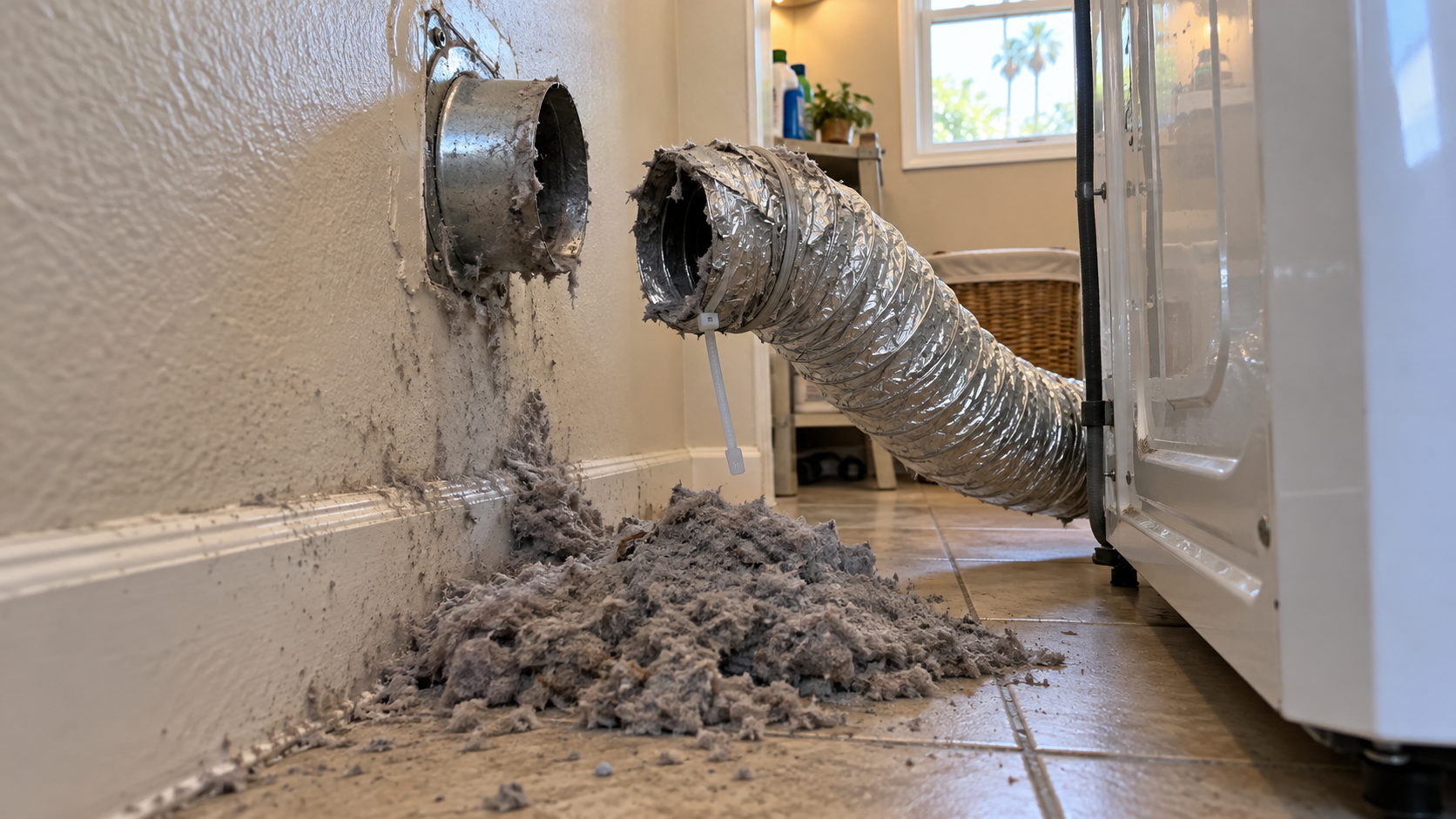
Inside, the duct was completely disconnected from the external vent. The dryer had been blowing lint behind itself instead of outside, and the pile back there was big enough that you could probably make a good-sized pillow out of it.
My best read on how it happened: the ducting was a bit too short, and the previous installer probably pulled it loose while shimming the dryer back into place. (Shims are the small wedges used to level an appliance.) It's an easy thing to miss, because it happens behind the dryer where nobody looks.
I replaced the flexible ducting with semi-rigid metal ducting and secured it with a clamp instead of the zip ties that had been holding it.
Here's why that pile matters. Dryer lint makes a perfect fire starter. My wife saves it from our dryer as free tinder for our family camping trips. However, it doesn't need to make it to the campground to be good tinder. That dry, fluffy stuff can go up in a second.
Jobs that seem this simple are some of the most satisfying I do, because it's genuinely a safety issue. It's a great feeling when you know you're making someone's house safer.
Why is my dryer suddenly taking two cycles to dry?
A dryer works by pushing hot, damp air out of the drum and out of the house. If that air can't get out, the moisture stays in the drum with your clothes, and the load takes longer.
The U.S. Consumer Product Safety Commission puts it plainly in its dryer safety alert: if clothing is still damp at the end of a typical drying cycle, or drying takes longer than normal, that "may be a sign that the lint screen or the exhaust duct is blocked."
So "two cycles" usually points to one of three things: a clogged duct, a duct that's come loose or been crushed, or a problem with the dryer itself.
How do I know if it's the vent and not the dryer?
You can narrow it down without a ladder or any tools.
- Step outside while the dryer is running. The CPSC says to check the outside vent "to make sure exhaust air is escaping." You should feel air coming out and see the flap opening. Weak air or a flap that stays shut usually means something between the dryer and that flap is blocked or disconnected.
- Look behind the dryer and on the laundry room floor. If the duct is properly connected to the outside vent, you shouldn't see lint on the floor or behind the unit. Lint back there means air is escaping somewhere it shouldn't, like it was in La Mesa.
- Check the lint screen. Clean it every load. If the screen is clean, the outside air feels strong, and the duct is connected, the vent may not be your problem.
If the duct isn't clogged or loose, the dryer itself may need an appliance technician instead of a duct cleaning. That's part of why we look at photos first.
What do flipped houses get wrong behind the dryer?
San Diego is notorious for badly flipped properties. I call it putting lipstick on a pig. The house looks great, but often nobody checked what's behind the washer and dryer.
The most common thing I find is a dryer vented into an attic or crawl space without ever being run to the outside. That's a whole different can of worms. Dryer exhaust is supposed to end outside the house. California's mechanical code requires dryer exhaust ducts to terminate on the outside of the building, and dryer makers say the same thing. GE's installation guidance says not to terminate the exhaust into an attic or a crawl space. When it dumps into an attic, all that moisture and lint stays in your house.
Next most common: flexible ducting with too many bends, or ducting crushed flat between the dryer and the wall. That's the silver accordion-style hose you see behind a lot of dryers. The CPSC recommends replacing plastic or foil accordion-type duct with rigid or corrugated semi-rigid metal duct, because the flexible kind "can more easily trap lint and is more susceptible to kinks or crushing, which can greatly reduce the airflow."
Out of sight, out of mind is not a philosophy that works with home services. The good news is that if there's already a vent to the outside and it just isn't connected correctly, a handyman can often get everything squared away.
When is a dryer vent more than a handyman job?
Some setups need a specialist. The ones I see:
- An HOA-managed condo. I work directly with homeowners and their personal rentals. If a job involves the HOA, I politely decline it instead of passing it along.
- A vent that needs a new roof jack. A roof jack is the fitting where a vent comes out through the roof. Adding one means cutting into the roof.
- A long hidden run. When the duct travels a long way inside walls or ceilings, it usually needs a dryer vent specialist.
When the job needs more than just a handyman, we'll let you know. And when we can, we'll refer you to someone that can help.
What should I send so you can tell whether it's a quick job?
We never ask a homeowner to jump on a ladder to get us a photo. Just send what you can safely reach:
- Behind the dryer. Pull it out a little if you can do that easily, and get the duct and the wall connection in the shot.
- The exterior vent, if it's at ground level or easy to see.
- The general area where the dryer sits. This tells us about access and whether the washer and dryer will be hard to move, so we come prepared.
Mostly we're looking for lint buildup and how the duct is routed. You can see what the service covers on our dryer vent cleaning page, and why photos lead to a better quote in Why a Good Handyman Quote Starts With Photos.
How do I keep it from happening again?
Once everything's connected right, I tell homeowners to do three simple things. Clean the lint screen every load. Every so often, peek behind the dryer: if you see lint on the floor or the wall, something's come loose. Then step outside while the dryer's running and make sure you feel air coming out and the flap is opening.
If your clothes start taking two cycles again, the laundry room gets hot, or you smell something burning, don't wait. Shut it off and have someone take a look.
Dryer vent questions people ask
Is it normal for the laundry room to get hot when the dryer runs?
A laundry room that's getting hotter than it used to is one of the warning signs I tell homeowners to watch for. Look behind the dryer. Lint on the floor or the wall means the duct may have come loose.
Can I clean my dryer vent myself?
The lint screen and the section you can reach behind the dryer, usually yes. The CPSC notes you may need to disconnect the duct from the dryer to clear a blockage, and reminds you to reconnect it to the dryer and the outside vent before using the dryer again. That reconnection step matters. A duct that comes loose when the dryer gets pushed back into place is how the La Mesa pile happened.
How often should a dryer vent be cleaned?
There isn't one schedule for every home. It depends on the dryer manufacturer's guidance, how much laundry you do, how long the vent is, how it's routed, and how much buildup you see. The three checks above will tell you more than a calendar.
Is lint really a fire risk?
The U.S. Fire Administration reports that "failure to clean (31%) was the leading factor contributing to the ignition of clothes dryer fires in homes from 2018-2020." (USFA)
Send over a few photos
If your dryer is taking two cycles or you're seeing lint behind it, send over some photos: behind the dryer, the exterior vent if you can see it from the ground, and the area around the dryer, plus your ZIP code. You can start here: Start Your Home Project.
We should get connected. And we'll take it from there.
If your dryer's still taking two cycles and you'd rather not pull it out and check it yourself, call or text me at (619) 815-7588.